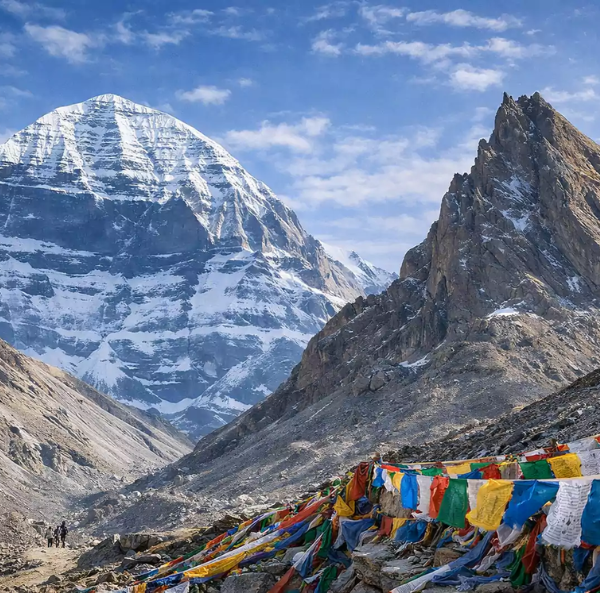
On the windswept Tibetan Plateau, at an altitude of over 4,500 meters, stands a mountain that is not merely a mountain. Its black, pyramidal peak—never successfully climbed—rises in solitude, flanked by two pristine lakes. For over two millennia, this landscape has served as a living map of the cosmos, a pilgrimage destination, and a point of theological convergence for four of Asia’s great traditions: Hinduism, Buddhism, Jainism, and the indigenous Bon religion.
This is Mount Kailash and Lake Manasarovar. But to understand what this place is, one must abandon modern cartography and enter the realm of sacred geography—where a river’s source is also the mouth of a mythical animal, where a mountain’s height is measured in yojanas, and where walking in a circle can erase the karma of lifetimes.
Across Hindu Puranas, Buddhist Tantras, and Jain Purāṇas, the geography of Kailash-Mansarovar is never just physical terrain. It is cosmic, symbolic, and deeply personal—a landscape etched into the collective memory of civilizations. Let us explore how each tradition maps this extraordinary terrain.
1. Hinduism: The Cosmic Axis (Mount Meru)
For Hindus, Kailash is the earthly manifestation of Mount Meru—the center of all physical, metaphysical, and spiritual universes. This is not poetry; it is cosmology.
The Skanda Purana and Vishnu Purana describe Kailash as the axis mundi, the pivot around which the entire cosmos rotates. Here, Lord Shiva sits in eternal meditation with his consort Parvati. The mountain itself is described as a palace of crystal, ruby, gold, and lapis lazuli.
But the most tangible feature of Hindu sacred geography is Lake Manasarovar. The name means “Lake of the Mind” (manas), for it was created by the mind of Brahma himself. Unlike its neighbor, the saline and turbulent Lake Rakshastal (associated with the demon king Ravana), Manasarovar is calm, circular, and freshwater—a symbol of purity and compassion.
The Four Rivers: From this sacred landscape, four of Asia’s greatest rivers originate symbolically:
Indus (flowing north)
Brahmaputra (flowing east)
Sutlej (flowing west)
Karnali (flowing south, a tributary of the Ganges)
The Mahābhārata (Vana Parva, Sections 139-176) treats Kailash differently than the Puranas. Here, it is a waypoint—the Pandavas cross “Kailasa of inconceivable grandeur” on their forest exile, noting that it is “six yojanas in height” and inhabited by Yakshas and Gandharvas serving Kuvera, the god of wealth. It is travel narrative, not cosmic revelation.
The Saptarishi Tradition: According to popular belief rooted in the Skanda Purana, the Seven Sages (Saptarishi)—Marichi, Atri, Angiras, Pulaha, Kratu, Pulastya, and Vashistha—visit Lake Manasarovar every morning at dawn (Brahma Muhurta) to perform their ablutions. Pilgrims have reported hearing the sound of splashing water from the lake during these early hours, attributed to the invisible presence of these ancient seers.
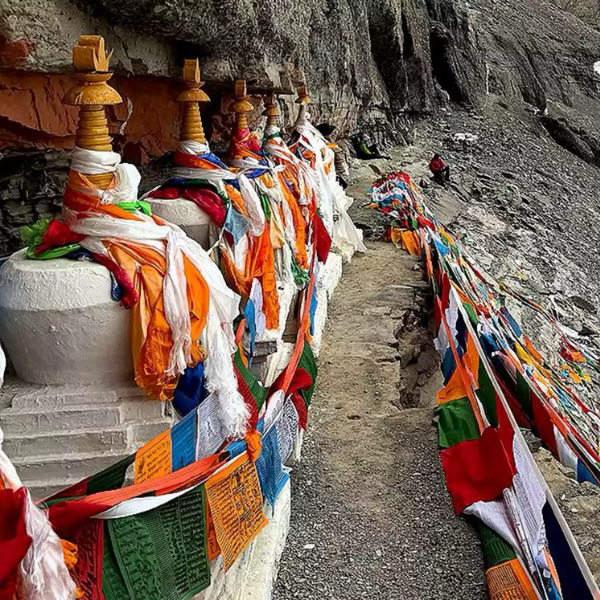
Saptarishi Cave, located along the sacred Mount Kailash parikrama route, is a revered meditation site associated with the seven ancient sages (Saptarishis). Pilgrims pass this narrow cliffside path adorned with prayer flags and chortens during their spiritual journey.
2. Buddhism: The Mandala Landscape
For Tibetan Buddhists, Kailash is known as Kang Rinpoche (“Precious Snow Mountain”). But the primary tantric text that maps this landscape is not the Kālacakra Tantra (often mistakenly associated with Kailash), but rather the Cakrasaṃvara Tantra.
The 24 Sacred Sites
According to this tantra, Mount Kailash is identified as Himavat (“The Snow Mountain”)—one of twenty-four sacred sites (pīṭha) that exist simultaneously on three levels:
Level
Description
External
Physical locations on the Tibetan landscape
Internal
Specific points within the practitioner’s subtle body
Secret
Meditational sites visualized during tantric practice
The narrative recounts that the Buddha Vajradhara, in wrathful form as a Heruka deity, subdued the demonic forces of Bhairava (Śiva’s fierce form) and blessed each of the twenty-four abodes as a mandala of the deity Cakrasaṃvara and his sixty-two wisdom deities.
The Three Holy Places of Tibet
Within the Kagyu school, Mount Kailash is grouped with two other sacred mountains as the “Three Holy Places of Tibet”:
Mount Kailash → Body of Cakrasaṃvara
Lapchi (la phyi) → Speech of Cakrasaṃvara
Tsari (tsa ri) → Mind of Cakrasaṃvara
What the Kangyur Says
The Kangyur (the Tibetan Buddhist canon) expands this geography into elaborate dimensions. Mount Meru (identified with Kailash) rises 80,000 yojanas above the earth and extends another 80,000 yojanas below—an hourglass-shaped mountain narrowing in the middle to 20,000 yojanas square, then widening at base and summit.
The four great rivers do not emerge from glaciers but from the mouths of mythical animals:
Lion’s Mouth (North) → Indus → grants the bravery of a lion
Peacock’s Mouth (South) → Karnali/Ganges → grants the beauty of a peacock
Horse’s Mouth (East) → Brahmaputra → grants the strength of a horse
Elephant’s Mouth (West) → Sutlej → grants the power of an elephant
The Historical Masters
Numerous Buddhist sages visited Kailash precisely because of this Cakrasaṃvara identification:
Gautama Buddha and 500 arhats flew to Kailash, leaving footprints in the rock
Guru Padmasambhava blessed the mountain in the 8th century
Jetsun Milarepa (11th century) held his famous miracle contest with the Bon shaman Naro Bonchung on Kailash’s slopes, leaving visible marks—footprints, handprints, and body imprints—in the rock
The Drigung Kagyu lineage sent hundreds of meditators to establish hermitages at all three sacred sites
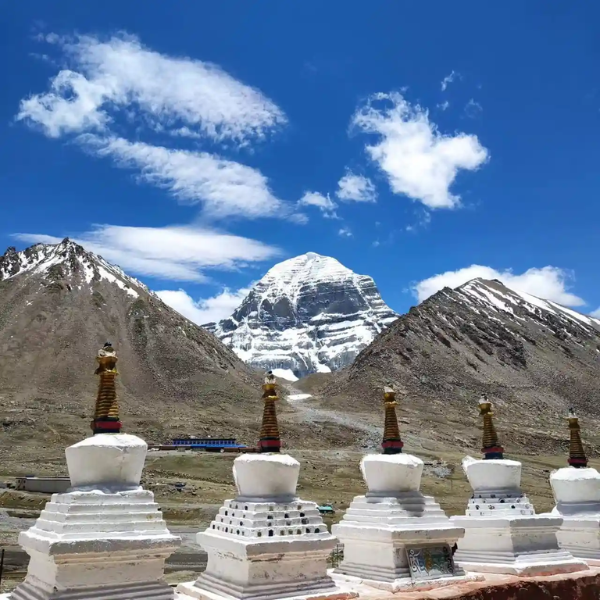
Zuthulpuk, one of the most important stops on the Mount Kailash parikrama route, offers a striking view of the sacred peak framed by white chortens and the vast Tibetan landscape.
3. Jainism: The Mountain of Liberation
For Jains, Mount Kailash is not called Kailash. It is Ashtapada—”Eight Steps.”
The Kalpa Sutra (attributed to Bhadrabahu, circa 4th century BCE) and the Adipurana (by Acharya Jinasena, 9th century CE) identify Ashtapada as the site where Rishabhanatha (Adinatha) —the first of the 24 Tirthankaras (ford-makers)—attained moksha (liberation from the cycle of birth and death).
What “Eight Steps” Means
The name “Ashtapada” carries profound symbolic meaning. It refers to the eight terraced steps of the mountain—or, according to tradition, the eight steps of the palace built there by King Bharat (son of Rishabhanatha). These eight steps represent the spiritual ascent toward liberation, the eightfold path that culminates in the soul’s final release.
A Geography of Soteriology
Unlike the elaborate river systems of Hindu texts or the mandala dimensions of Buddhist tantras, the Jain geography of Kailash is starkly focused:
Aspect
Jain Description
Primary Focus
The site of Rishabhanatha’s liberation
Geographical Detail
Minimal—the name Ashtapada is the key feature
Purpose
Veneration of the place where the first ford-maker crossed the ocean of suffering
For Jains, the physical journey to Kailash is a pilgrimage to the very spot where the path to liberation was first opened. The mountain is not a deity’s abode nor a cosmic diagram—it is a landmark of holy biography, a witness to the ultimate human achievement: the soul’s final release.
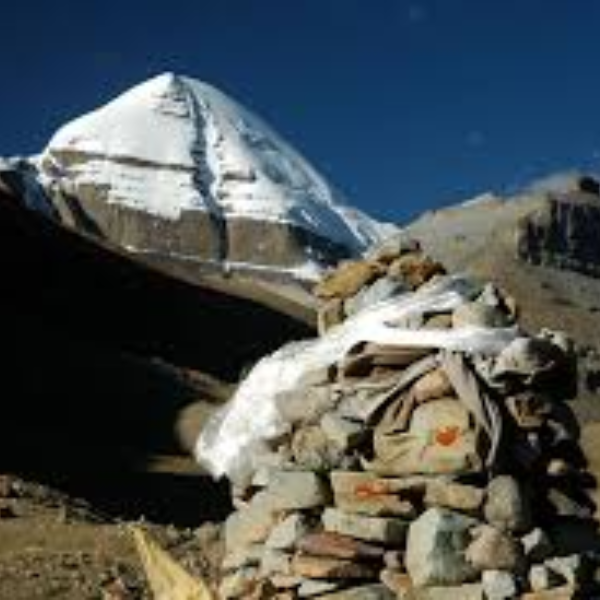
A stone cairn guides pilgrims along the rugged path to Ashtapad, with a sacred snow-clad peak rising beyond.
4. The Bon Tradition: The Reversed Landscape
No discussion of Kailash’s sacred geography would be complete without mentioning the Bon tradition—Tibet’s indigenous religion predating Buddhism.
For Bon practitioners, Kailash is not Kang Rinpoche but Yungdrung Gu Tsek (“Nine-Stacked Swastika Mountain”). The swastika (yungdrung) is a Bon symbol of eternity and indestructibility.
The Critical Difference: Direction
In a striking inversion of the Buddhist and Hindu traditions, Bon practitioners circumambulate Kailash counter-clockwise (gyung drung gyi kor), while Buddhists and Hindus walk clockwise.
This reversal reflects a deeper cosmological difference. For Bon, the mountain is the seat of the goddess Sipaimen (also known as Chamma), the “Queen of the World” and a female deity of wisdom. The landscape is mapped according to Bon’s own nine-vehicle path to enlightenment—a cosmology as sophisticated as any found in the other traditions.
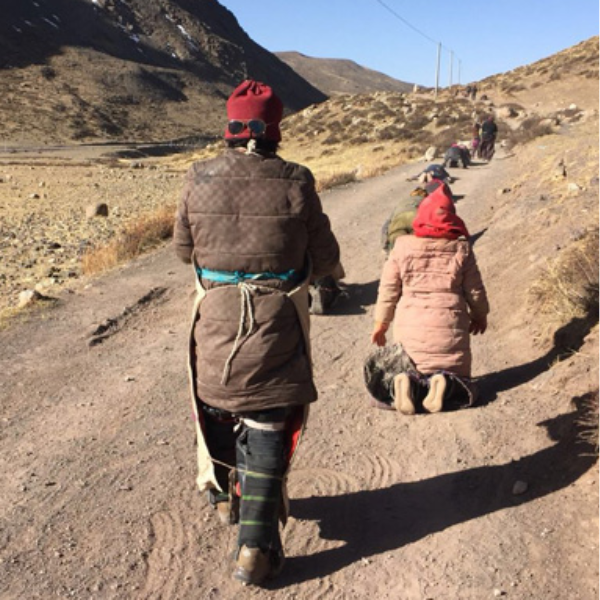
Devotees undertake the sacred kora around Mount Kailash, expressing deep faith through full-body prostrations along the rugged pilgrimage route. Photo source: original submission.
The Shared Practice: Circumambulation
Despite their theological differences, all four traditions share a common ritual practice: walking around the mountain.
Tradition
Term
Direction
Distance
Spiritual Benefit
Hindu
Parikrama
Clockwise
52 km
Burns away karmic debts
Buddhist
Kora
Clockwise
52 km
Generates merit, purifies negative actions
Jain
Parikrama
Clockwise
52 km
Honors Rishabhanatha’s liberation
Bon
Kora
Counter-clockwise
52 km
Honors the goddess Sipaimen
One full circumambulation is considered a powerful spiritual practice. The most devoted pilgrims perform 108 rounds—a number sacred across all traditions.
Textual Summary Table
Text
Tradition
Name for Kailash
Primary Feature
Skanda Purana
Hindu
Mount Meru / Kailash
Shiva’s abode, cosmic axis, Saptarishi visit at dawn
Vishnu Purana
Hindu
Mount Meru
Center of the universe
Mahābhārata (Vana Parva)
Hindu
Kailasa
Travel waypoint, “six yojanas in height”
Cakrasaṃvara Tantra
Buddhist
Himavat
One of 24 sacred sites, body mandala
Kangyur
Buddhist
Kang Rinpoche / Mount Meru
80,000 yojana height, four mythical rivers
Kalpa Sutra
Jain
Ashtapada
Site of Rishabhanatha’s liberation
Adipurana
Jain
Ashtapada
Eight-step spiritual ascent
One Landscape, Many Meanings
What makes Kailash-Mansarovar unique in the study of sacred geography is this palimpsest of meanings. The same physical peak—with its coordinates of 31°N, 81°E—simultaneously serves as:
Shiva’s cosmic abode where the Saptarishi bathe at dawn
The central point of a tantric mandala mapped onto the practitioner’s body
The eight-stepped mountain where the first Jain teacher attained final release
The nine-stacked swastika mountain of the Bon goddess, walked counter-clockwise
A Hindu, a Buddhist, a Jain, and a Bonpo can walk the same 52-kilometer path, trace the same ridgelines, drink from the same lake—and yet, in a very real sense, they are walking through completely different universes.
Perhaps that is the deepest truth of sacred geography. The land does not change. But what the pilgrim carries within—the scriptures, the stories, the centuries of accumulated meaning—transforms every stone, every stream, and every step into something infinitely more than rock and water.
It becomes a map of the soul’s journey home. It becomes civilization’s memory, written not in ink, but in the very contours of the earth.